 Hello.
With any luck, my trio will make another recording before the year is over. To this end, I have composed new material and am continuing to do so, in the hope that I can have a John Farnham moment such as preceded Whispering Jack where I sit in the backyard with a pile of papers and a rubbish tin, and turf the ones that simply aren’t good enough.*
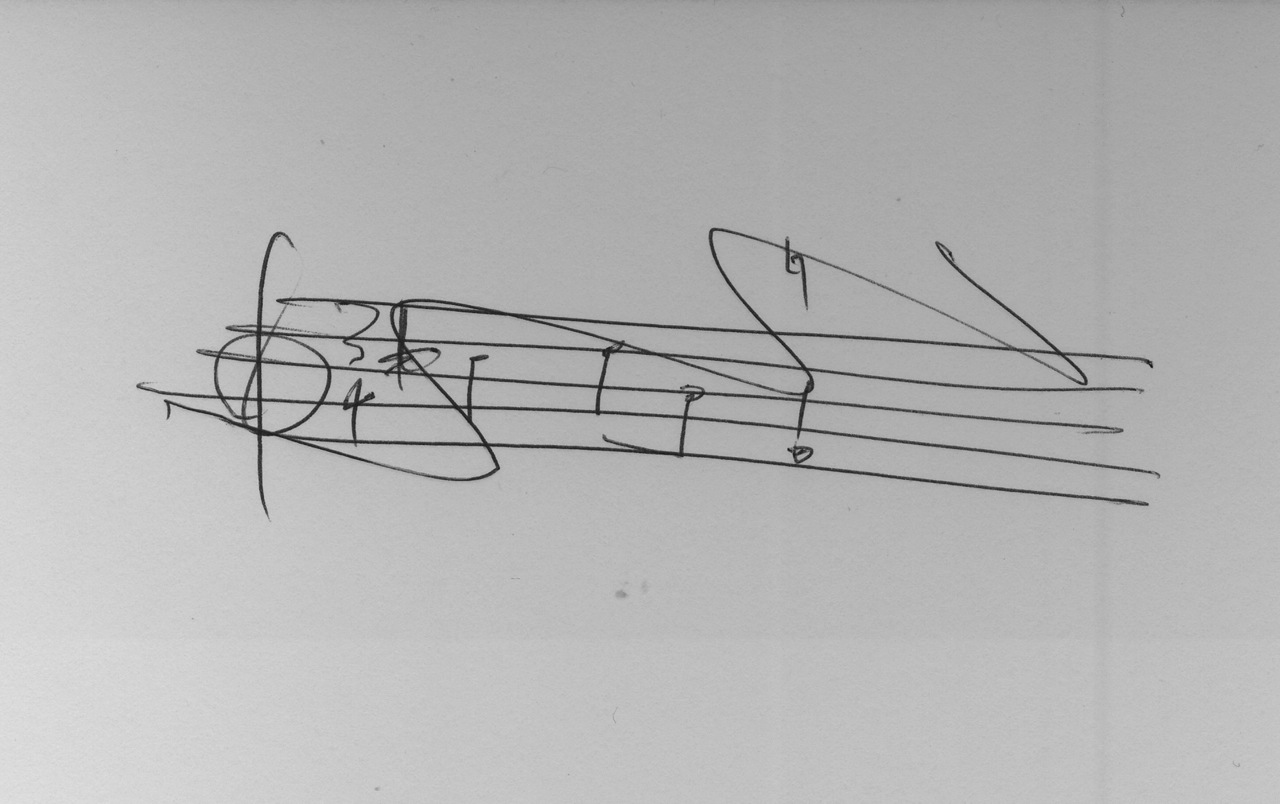
Composition is agony slash joy slash just enough to permit you to keep going. You have an idea, and you scribble something that might be hoped to resemble it, but the trick is to get enough on paper so as to prevent the rest from escaping between now and next time you look at it. On so many occasions the Great Idea has evaporated on return because the scribbles were insufficient. You think, what was I thinking? Or rather, what was I hearing? The things that, as you produced the idea, seemed so essential to it as to make it unnecessary to write them out, even had it occurred to you to do so (since, after all, they were so obvious, so intrinsic), are gone – and there’s just a bunch of notes and the memory of some feeling of meaning, now marked by a brightly lit lacuna.
The further you get with a piece the stronger it is, and perhaps by then you’ve played it over a sufficient number of times to have developed an aural and even a motor memory for it as well. And you put the chart into the computer, and print it off, and move on to the next one.**
So, dear reader (funny how when Charlotte Bronte said ‘Reader, I married him’ she was speaking to a generalised population of readers, momentarily embodied by the one holding the book, whereas I may actually be addressing a single one), I submit this item, written yesterday.
[EDIT: Twelve years later I’m reading this post, and I can tell you that the tune is entitled ‘Speaking with other parents about renovations’. It has been played several times by the trio, though never as yet recorded.]
This chart says all I need it to say. I know what I need to add to make it do what I want it to do; the manuscript is, for me, complete.*** I wonder though what it might mean to anyone else? As I play it, sometimes the quavers want to swing, and sometimes they don’t. Specific voicings are not specified, of course, and they’re open to considerable variation.
What I’d love is if anyone who read this, or passed it around, or whatever, took the chart and read it over and recorded a performance and sent it back. This would be fascinating. You know, because I and my fellow inmates here are the only ones to have heard it as yet, so it’s a measure of what the chart can convey, and what you want to contribute. mp3s to timothy [at] timstevens /dot/ com {dot} au
Have a great Tuesday. It’s a miserable morning here and I have to go to the dentist, so this has provided me with a happy distraction. My thanks.
*Somewhere along the line I heard that this is what he did. Perhaps the story is apocryphal. Perhaps I should ask Dave; he’s the kind of person who’d know for sure. Anyway, there it is.
**Ideally.
***I say this advisedly. Pieces themselves are never complete.
6/v/2013
 So who else caught Metropolis? To be honest, I only heard two concerts, the first and the last of the three with Thomas Adès, and I missed the one in between because a) it wasn’t included in the ‘subscription’ so initially I didn’t know it existed, and b) it was at 6.30pm, which seriously doesn’t work for me on a Monday.
I was involved in the Metropolis Festival a few years ago when Bramwell Tovey conducted Don Banks’s Nexus and I was on jazz piano. Heaps of fun. Ben Robertson played bass and David Jones was at the drums. Eugene Ball and Lachlan Davidson were also standing around, and perhaps there were some other jazzers – but let’s face it, we all sound the same to me. There were three concerts at the Malthouse in that series with Maestro Tovey in charge, and I went to all of them. After the second I wormed my way backstage and retrieved this (click on it if you want a better look):
EDIT: The clicky-thing no longer seems to work. I don’t know why. I’m sorry.
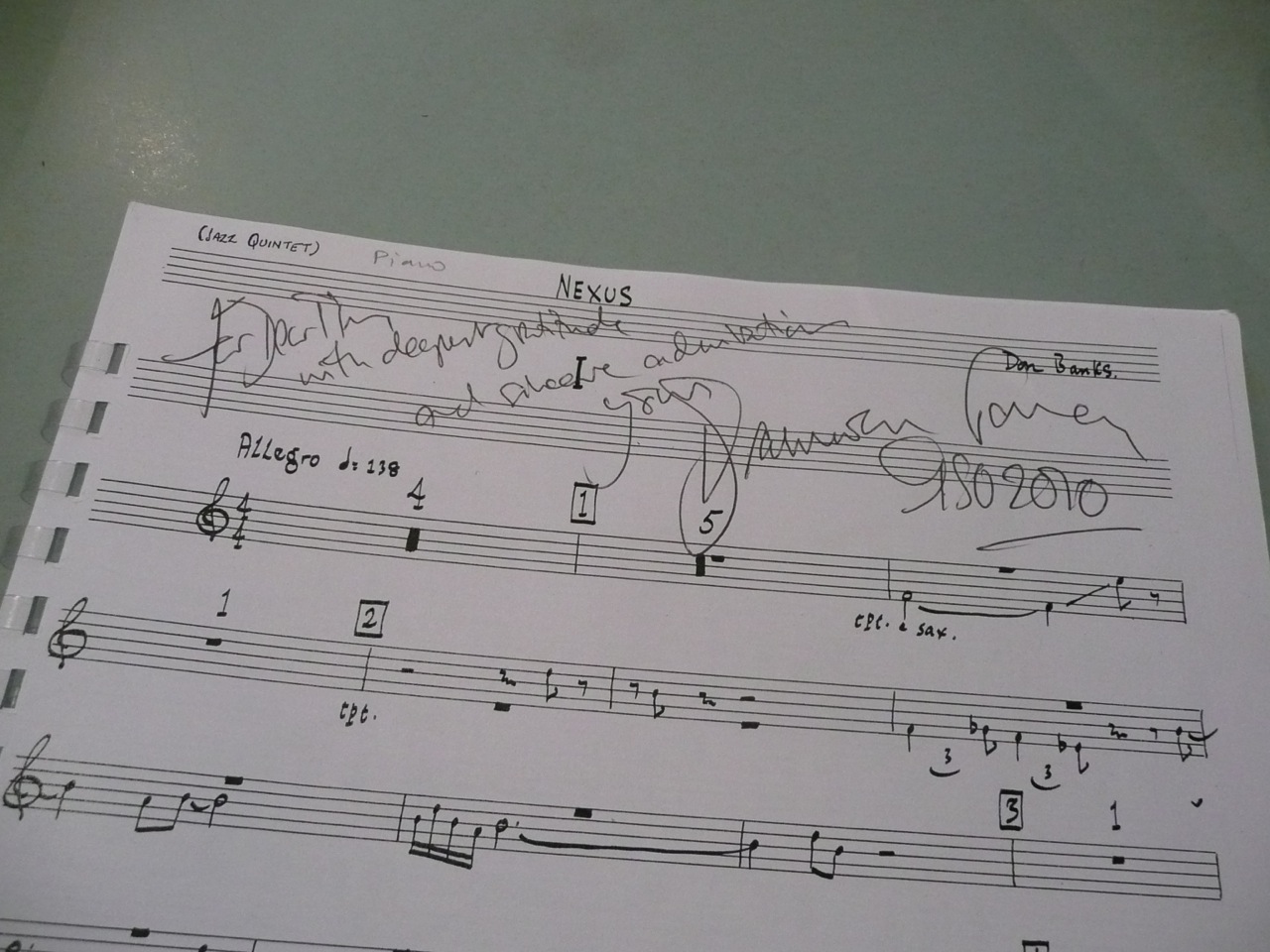
I’m such a damn’ groupie. Still, it’s a treasured possession and I say that with neither apology nor dissemblance.
There was this other time when I had a gig in Adelaide with Ben and Dave, and Emma Gilmartin, and as it turned out the nation was being toured at the same time by one Stephen Patrick Morrissey. He and his gang were much in evidence at Adelaide Airport, and by the time we’d reached Melbourne Emma had convinced me to front him and pop the question. He was lovely about it:
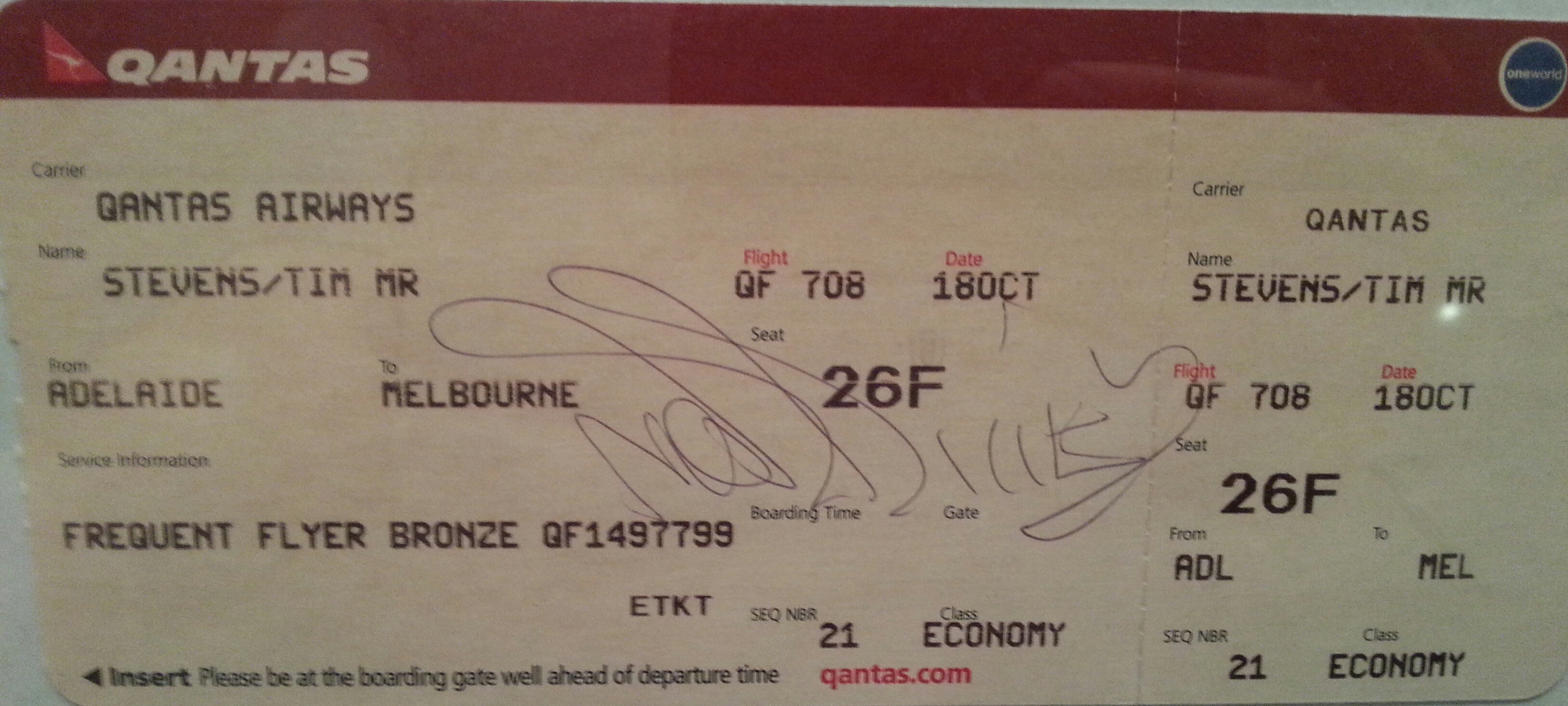
There are reflections in this photograph because yes, the boarding pass is in a frame. ‘I walked a pace behind you at the airport.’ Anyway, back to Metropolis: last year Steve Reich was here and there were some astonishing presentations at the Melbourne Recital Centre. eighth blackbird was in it too and but for the dreary conversation between its members and Mr Reich the whole experience might have resembled perfection. I’d only recently got properly acquainted with Reich’s music so he couldn’t have visited at a better time.
This time around it was Thomas Adès, someone about whom I found out after an article appeared in The Guardian (‘don’t you read The Guardian, Neil?!’) six years ago.
It amazes me to think that I’ve been alive at the same time as Keith Jarrett – in fact as far as I’m aware I still am – and even once I saw and heard him in the flesh. There was a time that Benjamin Britten was alive, when I was, and Witold Lutoslawski died still more recently. Beverley Farmer, whose work provided the epigraph (and, indeed, the title) for my most recent recording is still out there somewhere, although I’ve never met her, and I once wrote a silly fan letter to Patrick White while he was still with us. You can get, no, sorry, I can get, a bit silly about these things, and probably that’s my inner groupie coming out. But after a time (roughly six years) of getting to know Thomas Adès’s work, and finding that many parts of it stunned me petrifyingly, here I was at a Melbourne Symphony Orchestra concert watching him wave the stick over the Dances from ‘Powder Her Face’, or Concerto Conciso.
So it was I that I had to have this:
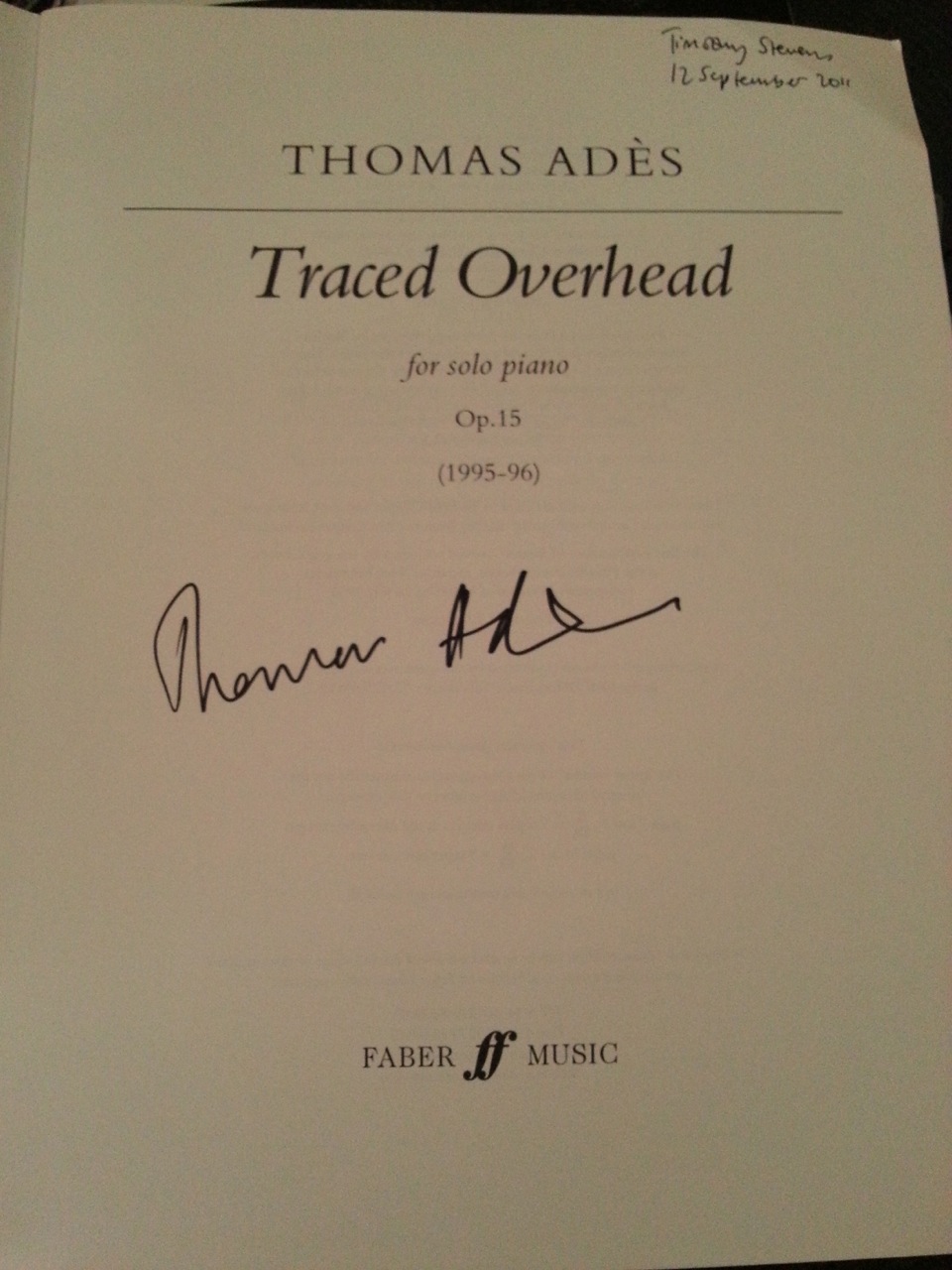
‘Ooh,’ said the composer, with some surprise. ‘Do you play it?’
‘Very, very slowly,’ I replied. (His performance takes twelve minutes; mine is currently down to about an hour and a half.) ‘But it’s a marvellous piece of music, and I love it. Thank you.’
So at least if I never make anything much of my own life, I met some top people.
21/iv/2013